
Is traveling independently by public transport a hurdle?
Virtual
OV verlaagt de drempel
Virtual OV helps neurodivergent people and others who experience barriers in public transport to safely practice independent travel. New Dutch residents, the elderly, and MBO students can also use this to practice step-by-step in a safe environment.
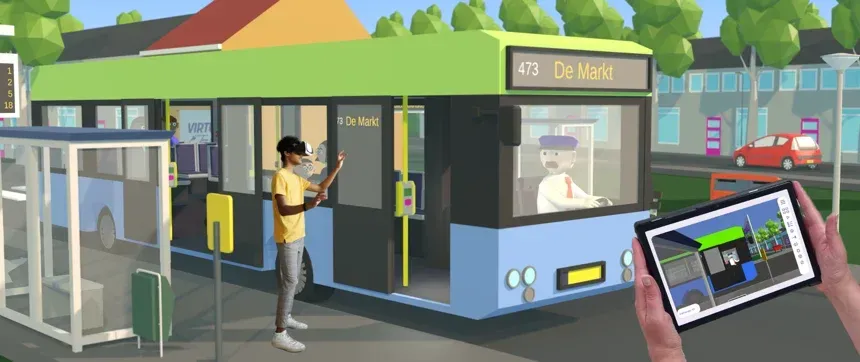
In realistic VR scenarios, participants build confidence, travel skills, and self-reliance before making the transition to real public transport.
From tension to naturalness, ready for the real world.
See how Virtual OV aligns with your organization:
Practice safely with public transport in VR
Virtual Public Transport helps participants practice situations that often cause tension in real life. Think of planning a route, checking in, transferring, dealing with crowds, or asking for help when things don't go as expected.
Each session strengthens:
- Executive functions: Time management (transfer times), maintaining attention (reading the route), planning (buying a ticket)
- Procedural memory: Automatic check-in, exiting at the rear door becomes second nature through repetition
- Self-confidence: I ask the conductor myself where I need to get off.
Result: Step-by-step guidance to the real world.
Voor wie is de training?
Virtual OVis ontwikkeld voor jongeren en volwassenen die extra ondersteuning nodig hebben bij zelfstandig reizen. Denk aan mensen met autisme, AD(H)D, NAH of prikkelgevoeligheid.
De training is ook inzetbaar voor nieuwe Nederlanders, ouderen en mbo-studenten binnen onderwijs, zorg, overheid en mobiliteit.
How does Virtual OV?
1. Veilig oefenen in VR
Deelnemers oefenen herkenbare OV-situaties zonder de druk en gevolgen van de echte reis.
2. Vaardigheden en vertrouwen opbouwen
Een docent of begeleider ondersteunt de deelnemer bij het oefenen en herhalen.
3. De stap naar de praktijk maken
De opgebouwde vaardigheden worden toegepast tijdens begeleide en uiteindelijk zelfstandige reizen.
Easy to use within education, healthcare, and government
Virtual OVwordt uitgevoerd door getrainde docenten en begeleiders binnen scholen en zorgorganisaties. Met het train-de-trainerprogramma leren zij deelnemers gericht te ondersteunen.
Gemeenten, regio’s en provincies kunnen de inzet mogelijk maken en meerdere organisaties binnen hun gebied laten aansluiten. Zo kan zelfstandig leren reizen structureel worden verbonden aan onderwijs, zorg en inclusief mobiliteitsbeleid.
Experiences from practice
“If you want to give them the world, teach them to travel.”
Behavioral expert Joke de Haan
"Traveling by public transport has given me the freedom I have now."
Former student - Spinaker Alkmaar
"Teacher, if I learn this, I'll be able to take the train to work later and won't have to take the bus anymore."
Student - The Chameleon Roosendaal
"Virtual public transport is a real game changer for our students."
Marloes Heidekamp - Kranenburg Practical Education
What makes Virtual Public Transport so effective is the fun factor. When our young people enjoy something, their responsive brain kicks in.
Dmitri Hazes – Head Care Alkmaar
What do participants practice?
Planning a route
- View the route in advance and recognize steps
- Understand departure times, stops, and transfers
Choosing the right bus or train
- Reading line numbers, directions, and information signs
- Check if the selected trip is correct
Dealing with delays and unexpected situations
- Stay calm during changes
- Look for an alternative or ask for help
Asking for help and social interactions
- Ask a question to a driver, conductor, or staff member
- Dealing with fellow travelers and crowds
Who we work with




Bedankt voor je bericht!
We hebben je bericht ontvangen en komen er zo snel mogelijk bij je op terug.
Discover what Virtual OV can mean for your organization
Would you like to explore how Virtual Public Transportcan help students, clients, or residents travel more independently?
Schedule a demo or contact us.