Virtual public transportfor special education and MBO
Students practice traveling independently on public transport safely and step by step.
For many students, traveling by public transport is not a matter of course. Crowds, transfers, delays, and social situations can cause stress. With Virtual Public Transport, they first practice these situations in a safe VR environment, at their own level and without consequences if something goes wrong.
If you want to give your students the world, teach them to travel!
For which students is Virtual OV suitable?
Virtual OVis suitable for students who want or need to practice traveling independently, but require extra support. For example, because they experience anxiety, have difficulty planning, become easily overstimulated, or feel insecure in unexpected situations.
The training is well-suited for students in special secondary education, practical education, and vocational education who are working on self-reliance, internship preparation, citizenship, or social participation.
Recognizable in students who:
- having trouble planning or maintaining an overview
- experiencing tension in busy or unfamiliar environments
- to feel uncertain during transfers, delays, or route changes
- finding it difficult to ask for help
- remain dependent on supervision or transport
- want to practice towards an internship, work, or further education
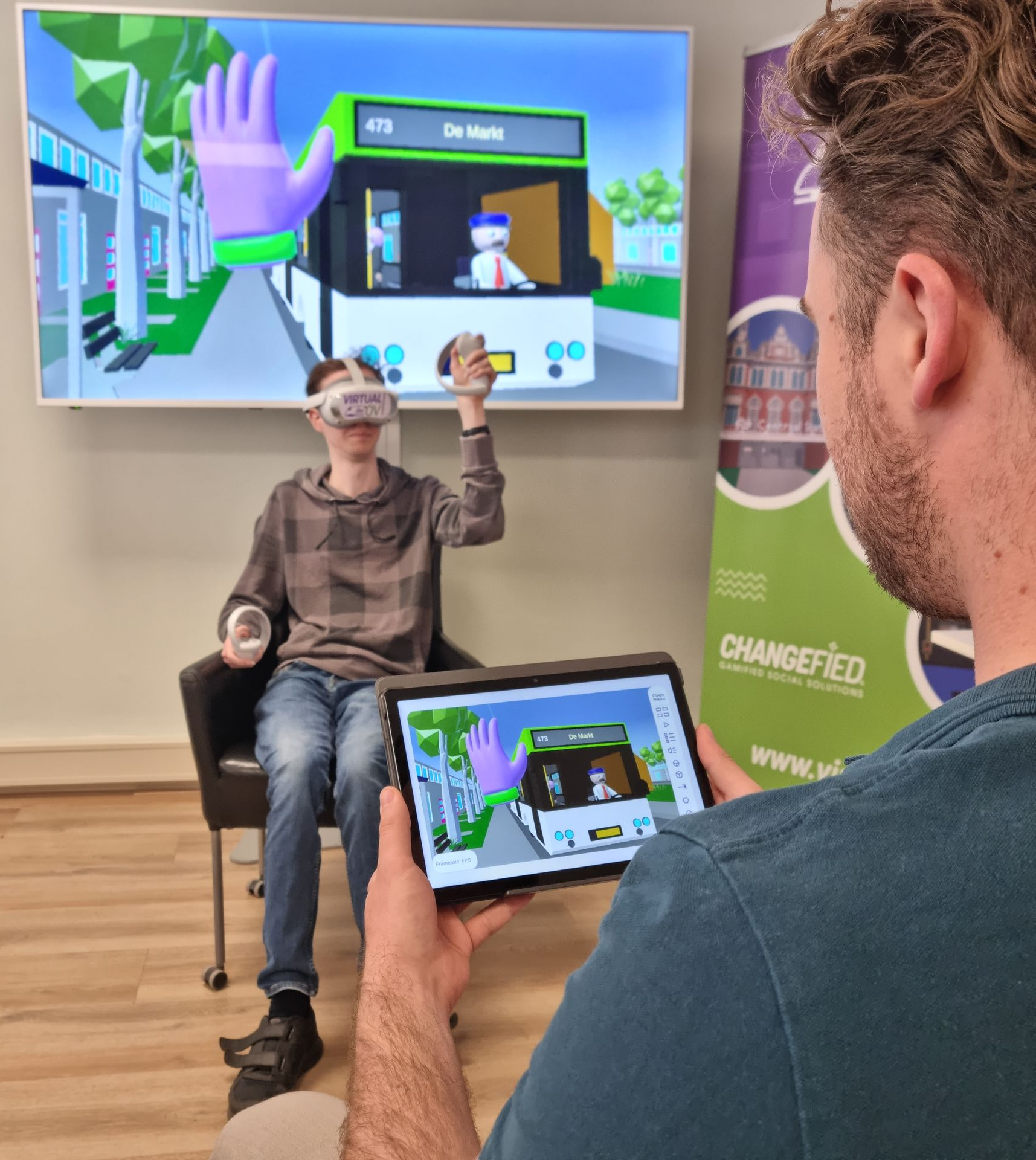
Practicing independent travel without the pressure of the real world
As a teacher or supervisor, you recognize students who want to travel more independently but get stuck due to sensory overload, uncertainty, or unexpected situations along the way. A missed bus, a busy station, or a question for the driver can be enough to build up tension.
Virtual Public Transport makes practice feasible. Students step into a realistic VR environment where they can safely experience, repeat, and build upon public transport situations. In this way, they practice not only the route but also managing tension, making choices, and reacting when things do not go as expected.
What students practice in Virtual OV
Students practice preparing for a trip, recognizing stops, reading travel information, and understanding the steps required to get from the starting point to the destination.
Planning a route
Students practice preparing for a trip, recognizing stops, reading travel information, and organizing the steps needed to get from the starting point to the destination. In doing so, they train planning, overview, and working memory.
Choosing the right bus or train
In the VR environment, students practice with line numbers, directions, information signs, and checking whether they are at the correct stop or on the correct platform.
Dealing with delays and unexpected situations
Students experience what they can do in the event of a delay, a detour, a missed connection, or a change in the route. They practice shifting gears, staying calm, and choosing the next step.
Asking for help and social interactions
Virtual OV allows students to practice situations in which they ask for help from a driver, conductor, staff member, or fellow passenger. In this way, social interaction becomes part of the training, without the pressure of the real world.
Training executive functions and procedural memory
Virtual OV is more than a safe VR practice environment. The training is designed to allow students to actively practice the skills needed to travel independently: planning, maintaining attention, remembering information, making choices, and adapting when things do not go as expected.
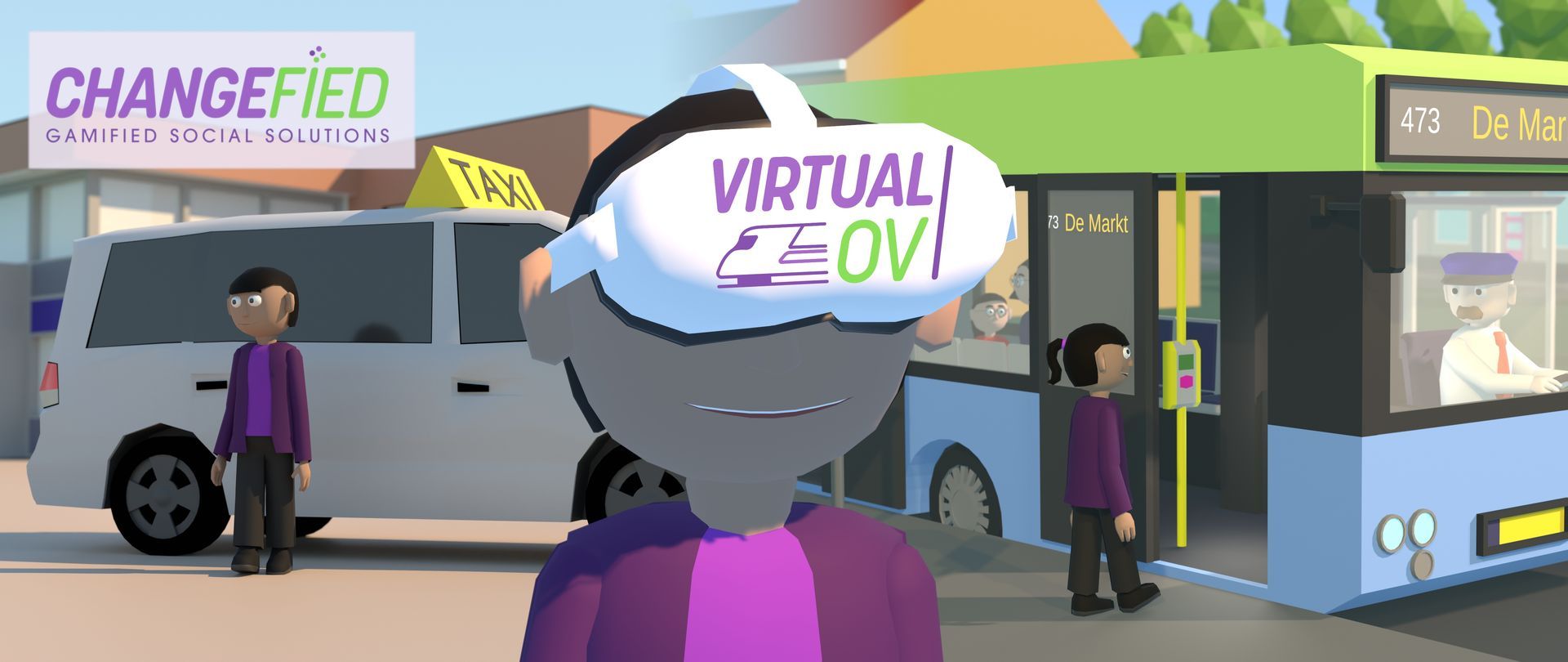
By practicing realistic public transport situations multiple times, students build routines. Checking in, recognizing the correct stop, transferring, or asking for help is not only explained but also repeatedly experienced. In this way, Virtual Public Transportstrengthen executive functions and build procedural memory.
Students practice with, among other things:
- planning and preparing a travel itinerary
- using working memory, such as remembering where they need to get off
- maintaining attention during multiple steps
- Responding flexibly to delays, diversions, or congestion
- perform actions in the correct order
- repeat routines until they become more familiar and automatic
Connection to citizenship and self-reliance
Virtual Public Transportmakes citizenship and self-reliance practiceable. Students practice making choices, asking for help, interacting with others, and participating in a recognizable public transport situation.
The training aligns with SLO core objectives for citizenship, particularly self-reliance and participation. Schools can link the scenarios to their own CED learning pathways and exit profile, from day activities to internships.
Independent travel is therefore not a standalone mobility goal, but a concrete exercise in daily participation.

What do students gain from it?
Virtual OV helps students gain more control over traveling by public transport step by step. The goal is not for every student to travel completely independently immediately, but rather to make the step towards independence smaller, safer, and better guided.
Possible returns are:
- more self-confidence in public transport situations
- better able to plan, remember and switch
- Less tension through recognition and repetition
- more independence regarding internships, work, further education, and free time
- more confidence to ask for help when needed
What do teachers and supervisors gain from this?
Virtual OVhelps not only students, but also teachers and supervisors. The training makes visible where a student gets stuck and provides a safe way to repeatedly practice travel skills.
For teachers and supervisors, this means:
- A safe practice environment without immediately going onto the real route
- More insight into students' tension, choices, and support needs
- Repeatable scenarios that align with different levels
- A practical link to citizenship, self-reliance, and participation
- Less reliance on scarce practice opportunities in the real world
In this way, learning to travel independently does not become a standalone activity, but a concrete learning experience that fits within daily guidance and educational practice.
Easilydeployable in school practice
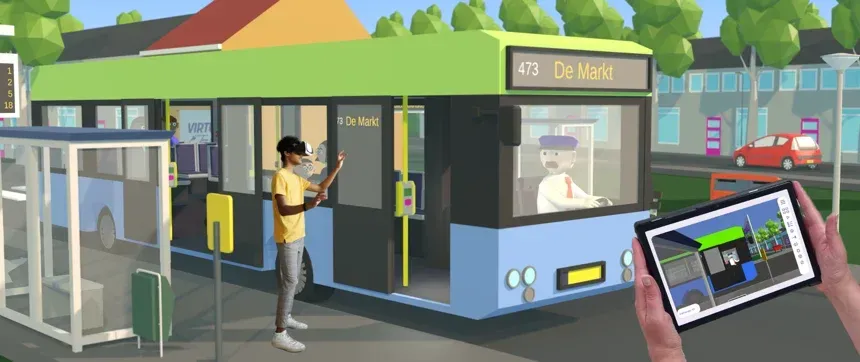
Virtual Public Transport has been developed to be practically applicable within education and guidance. The training uses a VR headset and realistic public transport scenarios. Students practice individually or under supervision, while the teacher or supervisor can gradually build up the skill level.
With the train-the-trainer program, teachers and supervisors learn how to use Virtual Public Transport safely, effectively, and purposefully. In this way, VR does not become a standalone technology, but a useful tool within lessons, guidance, citizenship, or self-reliance programs.
Virtual public transport is:
- suitable for use in special secondary education, practical education, and secondary vocational education
- suitable for individual guidance and group-oriented learning trajectories
- to be combined with citizenship, mobility training and internship preparation
- repeatable, scalable, and adaptable to the student's level
Why is this interesting for school management?
Virtual OVhelps schools make self-reliance, citizenship, and participation concrete. Students practice skills that are important for internships, further education, work, leisure time, and social contacts.
Virtual OVinteresting for school management because it aligns with existing educational goals, is practically applicable within guidance, and visibly contributes to future-oriented and inclusive education.
Relevant for school management because Virtual OV:
- aligns with citizenship, CED learning pathways, and self-reliance
- can be used within existing guidance and educational goals
- prepares students for internships, work, and social participation
- gives teachers more insight into support needs
- offers a concrete tool for inclusive and future-oriented education
Experiences from practice
The strength of Virtual OVlies not only in the technology, but above all in what it makes possible for students and supervisors.
“If you want to give them the world, teach them to travel.”
Behavioral expert Joke de Haan
"Traveling by public transport has given me the freedom I have now."
Former student - Spinaker Alkmaar
"Teacher, if I learn this, I'll be able to take the train to work later and won't have to take the bus anymore."
Student - The Chameleon Roosendaal
"Virtual public transport is a real game changer for our students."
Marloes Heidekamp - Kranenburg Practical Education
What makes Virtual Public Transport so effective is the fun factor. When our young people enjoy something, their responsive brain kicks in.
Dmitri Hazes – Head Care Alkmaar
Virtual OV opens doors — but starts with your reality as a teacher.
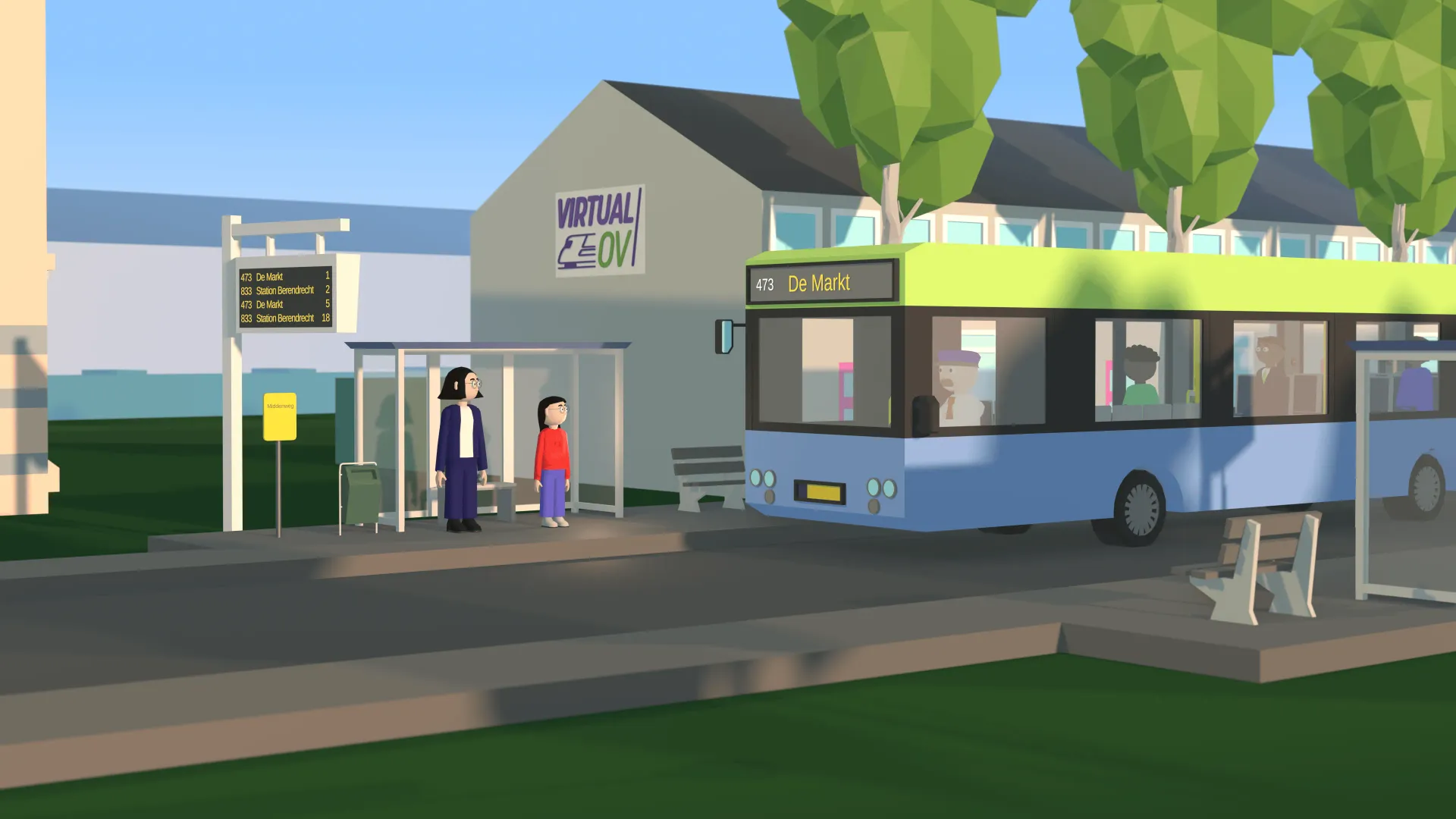
Your students dream of internships, work, or cultural outings, but the first step—traveling independently—often remains an obstacle due to fear, unpredictability, or differences in ability levels.
Virtual OV is your solution: safe VR exercises that promote social skills and self-reliance for real social participation.
Do you want to discover how it can enhance your lessons?
Schedule a free demo today and experience firsthand how students develop and how you can report measurable impact.
Who we work with

New Mobility Foundation

NS

Arriva

Knowledge platform
CROW




Frequently asked questions from schools
For which students is Virtual OV suitable?
Virtual OVis suitable for students who need extra support with independent travel, for example due to autism, AD(H)D, acquired brain injury, sensory sensitivity, anxiety, or difficulty with planning.
Do teachers need to have experience with VR?
No. With the train-the-trainer program, teachers and supervisors learn how to use Virtual OVsafely and practically.
Does Virtual Public Transport fit within citizenship?
Yes. The training aligns with citizenship, self-reliance, participation, social functioning, and CED learning pathways.
Does Virtual Public Transport replace practicing in real life?
No. Virtual Public Transport is a safe intermediate step. Students practice in VR first and can then make the transition to real public transport situations better prepared.
How do we start as a school?
The first step is a demo or introduction. During this, we look together at your students, goals, and practical application.
Thank you for contacting us.
We'll get back to you as soon as possible.
We got it.
Get started with Virtual Public Transport
Would you like to explore how Virtual OVcan help students travel more independently? We are happy to brainstorm with you regarding its implementation within your school, target group, or support program.
Schedule a demo and experience how students can safely practice situations that are stressful or unpredictable in real public transport.